Home > Products > Specialist Fire Suppression > Gaseous Fire Extinguishing Systems > Inert Gas Fire Suppression Systems
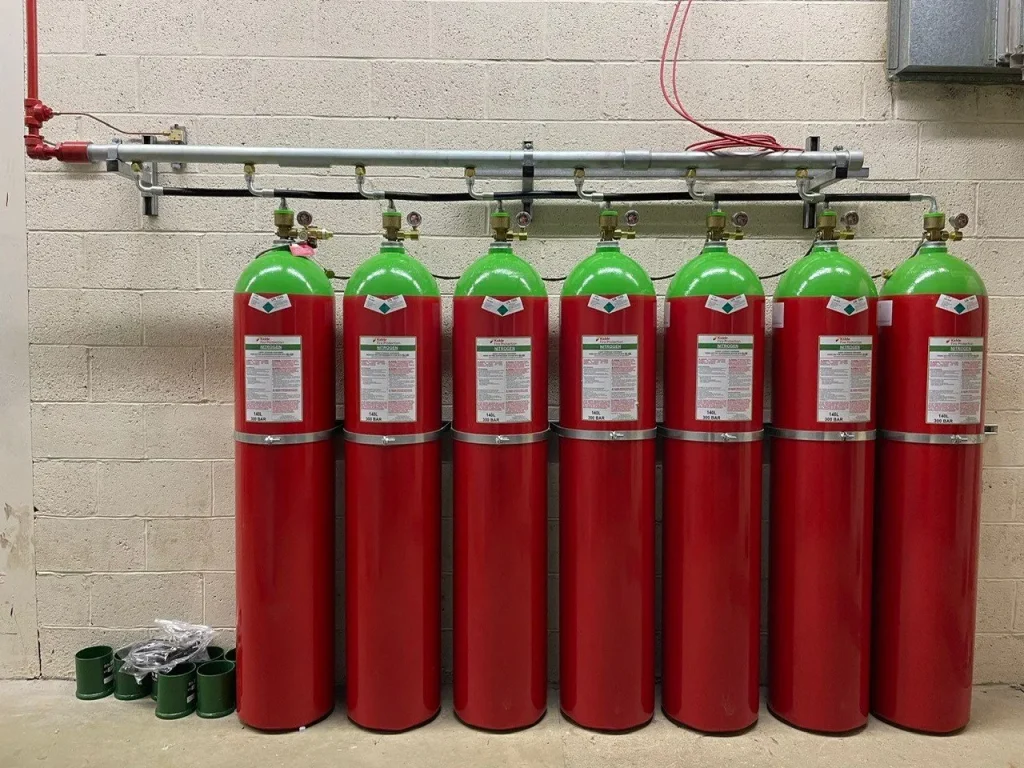
Inert gas fire suppression uses naturally occurring gases, nitrogen, argon or a blend, to extinguish fire by reducing the oxygen in a room to a level that no longer supports combustion, while remaining safe for people. Because the agents are simply atmospheric gases, they have zero ozone depletion and zero global warming potential, and leave nothing behind. MEP designs and installs inert gas systems for data centres, power and process environments where clean, environmentally sound protection is essential.
Normal air contains around 21 percent oxygen. Inert gas systems lower this to roughly 12 percent, below the level that sustains most fires, but still safe for anyone in the room to breathe for the short period involved. The gas is stored under high pressure in cylinders and discharged through a network of pipework and nozzles, typically reaching design concentration within 45 seconds. Because it displaces oxygen evenly, it reaches every part of the enclosure, including behind cabinets and under raised floors.
Inert systems use one of four agents, all carrying the IG prefix: IG-01 (pure argon), IG-100 (pure nitrogen), IG-55 (a 50/50 argon and nitrogen blend, known as Argonite) and IG-541 (nitrogen, argon and a little CO2, known as Inergen). They perform similarly but differ in density, cylinder count and cost, which affects storage space and pipe runs. We assess your enclosure and available plant space to recommend the most practical agent for the installation.
Get in touch with our team of fire suppression experts to discuss your requirements and receive a tailored solution.
It reduces the oxygen concentration in the room from around 21 percent to about 12 percent, which is too low to sustain combustion but still safe for people for the short exposure involved.
Yes, when the system is designed to BS EN 15004 the reduced oxygen level stays within safe limits for the required hold time. IG-541 also includes a small amount of CO2 to help the body cope with the lower oxygen.
They differ in composition: IG-01 is argon, IG-100 is nitrogen, IG-55 is a 50/50 blend and IG-541 adds a little CO2. Performance is similar; the main practical differences are cylinder quantity and storage space.
No. They use gases already present in the atmosphere, with zero ozone depletion potential and zero global warming potential, and are not affected by F-gas phase-down rules.
The main trade-off is cylinder storage. Because the gas is stored compressed rather than as a liquid, inert systems need more cylinders and space than chemical clean agents.
Some other offerings by MEP that you might be interested in.